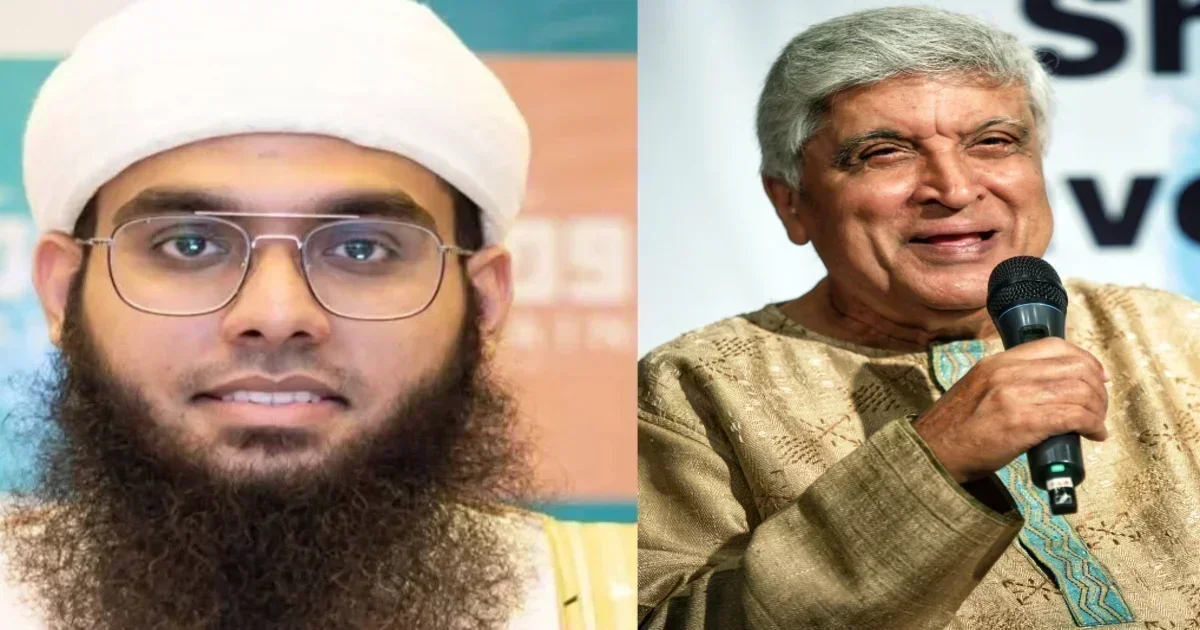
For audiences across South Asia, the widely circulated public debate between Mufti Shamail Nadwi and Javed Akhtar was difficult to ignore. Across social media platforms, discussion clips, reaction videos, and long-form analyses were shared rapidly. Within days, millions of views were recorded, while reuploads pushed the total reach far higher. The debate was widely described as one of the most consequential intellectual exchanges in recent Urdu-Hindi public discourse.
Despite predictable criticism from ideological opponents, the exchange was received positively by large segments of the public. Among Urdu-Hindi-speaking viewers especially, a broad consensus emerged. Conceptual clarity, philosophical depth, and methodological discipline were perceived to have been demonstrated more consistently by Mufti Shamail Nadwi. This perception shaped the broader narrative surrounding the debate and continues to inform ongoing discussions.
What follows is a fully rewritten, analytical, and accessible examination of the debate’s deeper philosophical dimensions. Attention is given to metaphysics, aesthetics, intellectual heritage, and the limits of scientific explanation. The discussion is framed for a general South Asian readership while maintaining philosophical rigor.
Public Reception and Cultural Significance
The debate was not received merely as a personal confrontation. It was framed, instead, as a symbolic encounter between two intellectual traditions. On one side, Islamic philosophical theology was articulated within a classical metaphysical framework. On the other, modern South Asian atheism was presented through cultural intuition, moral sentiment, and skepticism toward religious authority.
Javed Akhtar’s unique stature amplified the debate’s impact. He has long been recognized as a prominent literary figure in India. His contributions as a screenwriter, poet, and lyricist have shaped popular culture for decades. Simultaneously, his public advocacy of atheism positioned him as a leading secular voice. Because of this dual identity, the exchange attracted audiences far beyond theological circles.
English subtitles later expanded the debate’s reach internationally. As a result, philosophical arguments once confined to madrasa classrooms and academic texts entered mainstream conversation. This shift itself was notable, as abstract metaphysics rarely commands mass attention in contemporary media spaces.
Contingency and the Question of Existence
A central feature of the debate was the discussion of contingency and necessity. These concepts were treated not as theological slogans but as foundational metaphysical distinctions. Within classical philosophy, a contingent being is defined as something whose existence is not self-explanatory. Such a being may exist or may fail to exist. Its reality depends upon factors beyond itself.
By contrast, a necessary being is understood as that which must exist. Its existence is not derived from anything else. In Islamic metaphysics, this necessary being is identified as God. The argument does not rely upon cosmology, temporal beginnings, or physical mechanisms. Instead, it addresses a more fundamental question: why anything exists at all.
During the debate, unfamiliarity with this framework was openly acknowledged by Javed Akhtar. This admission was perceived by many viewers as revealing a significant asymmetry. The contingency argument has been a staple of philosophical theology for centuries. Its absence from an atheist critique was therefore viewed as a serious limitation.
Infinite Regress and Explanatory Failure
Closely related to contingency is the problem of infinite regress. If every explanation depends upon a prior explanation without any terminating ground, then explanation itself is undermined. An endlessly deferred answer never becomes an answer at all.
Islamic theologians within the kalam tradition emphasized this point repeatedly. Figures such as Imam al-Ghazali argued that an infinite regress of causes cannot account for existence. The chain must ultimately terminate in something that does not require further explanation.
Later scholars, including Fakhr al-Din al-Razi, refined this reasoning further. Even if an eternal universe were granted for argument’s sake, metaphysical dependence would remain unchanged. Eternity does not transform contingency into necessity. An eternal contingent reality would still require an explanation for why it exists rather than not.
This distinction proved crucial. Scientific models may describe how the universe behaves once it exists. Metaphysics asks why existence itself is present. These domains were carefully separated in Islamic philosophy, and this separation structured Mufti Shamail’s reasoning throughout the debate.
Science, Metaphysics, and Category Errors
One recurring theme in public reactions was the tendency to conflate scientific explanation with metaphysical explanation. Appeals to evolution, cosmology, or neuroscience were frequently invoked by critics as if they addressed the same question posed by the contingency argument.
However, a category error is committed when descriptive science is used to dismiss metaphysical inquiry. Science explains processes within existence. It does not explain existence itself. This limitation is methodological rather than ideological.
Islamic philosophy has historically recognized this boundary. The contingency argument does not compete with science. It operates at a different explanatory level. As a result, dismissals grounded solely in empirical description fail to engage the argument’s actual claim.
This distinction was repeatedly emphasized during the debate. It was this methodological clarity that many viewers found compelling. Atheism, as presented, appeared to rely more heavily on cultural sentiment than on sustained engagement with metaphysical structure.

Buddhist Philosophy and Misapplied Critiques
In response to the contingency argument, some polemicists appealed to Buddhist philosophy, particularly the thought of Nagarjuna. Concepts such as emptiness were invoked to undermine metaphysical grounding altogether. These appeals, however, were widely regarded as selective and instrumental.
Nagarjuna’s critique was directed against reified notions of self-existence. It was not intended to dissolve explanation as such. His philosophy operated within a metaphysical framework that sought deeper reality beyond naive substance metaphysics.
When Madhyamaka thought is used to negate all grounding, global skepticism results. Such skepticism undermines not only theism but rational explanation itself. Scientific realism, ethical reasoning, and even Buddhist soteriology become unintelligible under such a framework.
As a result, these references were perceived less as principled philosophical engagement and more as rhetorical devices. The critique failed to address the actual structure of the contingency argument and instead diverted attention from its core claims.
Beauty Beyond Function and Evolution
Beyond metaphysics, the debate raised questions about aesthetics and meaning. Javed Akhtar’s artistic legacy was brought into focus, particularly his celebrated composition Afreen Afreen. The song’s language is saturated with reverence, excess, and transcendence. Beauty is not described merely as pleasing but as overwhelming and almost sacred.
Evolutionary psychology often explains art through mechanisms such as sexual selection or adaptive signaling. These theories may account for why aesthetic behaviors persist. However, they struggle to explain why beauty is experienced as intrinsically meaningful rather than instrumentally useful.
In Afreen Afreen, praise is repeatedly directed toward the Creator. This invocation is not incidental. Beauty is presented as demanding acknowledgment. Reductionist vocabularies fail to capture this demand. Description alone proves insufficient.
The argument is not that atheists cannot produce art. Rather, it is that the metaphysical depth presupposed by such art sits uneasily within strict naturalism. The language of transcendence appears to draw upon inherited frameworks that atheism itself cannot fully justify.
Intellectual Inheritance and Cultural Memory
Javed Akhtar’s intellectual formation did not occur in isolation. He emerged from a North Indian Islamic–Urdu scholarly lineage shaped by centuries of theological, philosophical, and poetic engagement. Figures such as Fadl al-Haqq Khayrabadi exemplified this tradition, combining logic, metaphysics, and resistance to colonial power.
Even when belief weakens, conceptual grammar often remains intact. The metaphysical inheritance continues to shape imagination, language, and aesthetic judgment. This inheritance becomes visible in Akhtar’s work despite his explicit atheism.
It was therefore argued that an environment shaped exclusively by eliminativist assumptions would erode the very conditions that make such art intelligible. Beauty, when stripped of transcendence, risks becoming trivialized.
Faith, Return, and Open Doors
The debate’s broader significance extends beyond victory or defeat. It highlights a deeper civilizational question. Can metaphysical inheritance be indefinitely disowned without cost? Can beauty, reason, and meaning survive within minimal frameworks?
Islamic theology offers a distinct answer. Human error and rejection are acknowledged. However, the possibility of return is always emphasized. Despair is explicitly discouraged, and mercy is foregrounded.
The Qur’anic assurance that forgiveness remains open to all underscores this orientation. Faith is not reduced to sentiment alone. It is presented as a framework capable of sustaining reason, resistance, and beauty across generations.
In this sense, the debate was not merely about atheism or theism. It was about the intellectual conditions that make thought itself possible. For many viewers, this realization proved more enduring than any rhetorical exchange.
Conclusion
The Mufti Shamail Nadwi–Javed Akhtar debate resonated widely because it exposed underlying philosophical divergences. Metaphysical clarity, aesthetic depth, and intellectual inheritance were brought into sharp relief. While conclusions differed, the structure of reasoning mattered most.
For South Asian audiences, the exchange served as a reminder. Ideas carry histories, and beauty carries metaphysics. When those foundations are examined carefully, deeper questions inevitably emerge.
